Why Ignoring Forward Head Posture Can Lead to Chronic Headaches

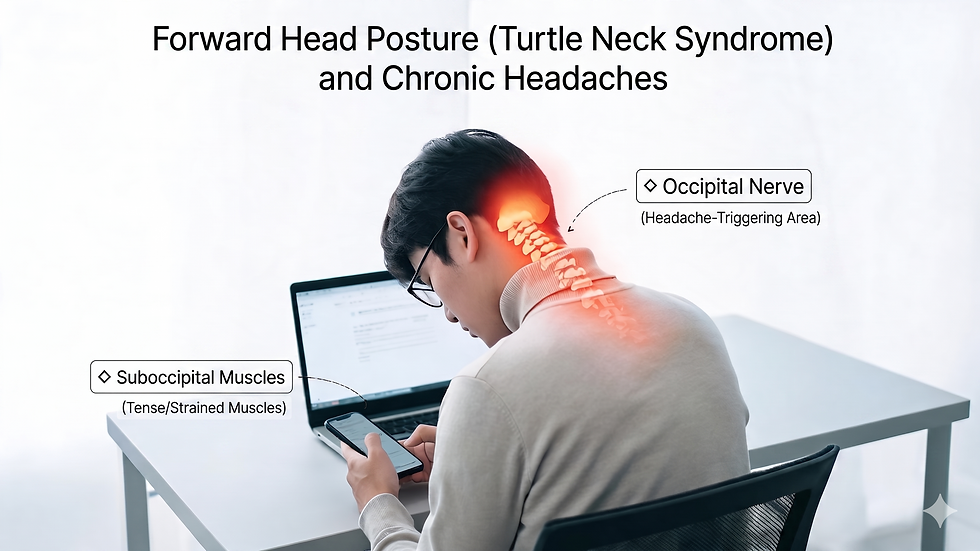
With the widespread use of smartphones and computers, forward head posture—often called “text neck”—has become increasingly common. While many people think of it as just a posture issue, it can actually be a major contributor to chronic headaches.
Even a slight forward tilt of the head significantly increases the load on the cervical spine. Research shows that for every inch the head moves forward, approximately 10 pounds (about 4.5 kg) of additional force is placed on the neck. Over time, this excessive load causes the suboccipital muscles at the base of the skull to remain in a constant state of tension.
This sustained muscle contraction can compress the occipital nerves that pass through the area, leading to headaches that often start at the back of the head and may radiate toward the eyes. These are not just simple tension headaches—they are often posture-induced and nerve-related.
A study published in Cephalalgia found that patients with chronic tension-type headaches had significantly more trigger points in the suboccipital muscles compared to healthy individuals. Furthermore, the severity of forward head posture was positively correlated with headache intensity.
In clinical practice, addressing this issue often requires more than basic stretching. Traditional East Asian medicine uses approaches such as acupuncture and herbal acupuncture (pharmacopuncture) to release muscle tension more effectively. Pharmacopuncture involves injecting purified herbal extracts into specific acupuncture points, helping reduce inflammation and relieve nerve compression.
Ultimately, posture is not just about appearance—it directly affects neurological and musculoskeletal health. Small daily habits can either contribute to chronic pain or help prevent it.
참고 문헌 (References)
Hansraj, K. K. (2014). Assessment of stresses in the cervical spine caused by posture and position of the head. Surgical Technology International, 25, 277–279.
Fernández-de-Las-Peñas, C., et al. (2006). Myofascial trigger points and forward head posture in tension-type headache. Cephalalgia, 26(4), 454–460.
Bogduk, N. (2003). The anatomy of occipital neuralgia. Clinical and Experimental Neurology, 40, 95–103.
Lee, J. H., et al. (2017). Pharmacopuncture in Korea: A systematic review and meta-analysis. Evidence-Based Complementary and Alternative Medicine, 2017.


Comments